


Why we invested in Display.dev?
Curiosity VC has made a pre-seed investment into Display.dev, alongside Outlast Fund and Firstpick, with angel participation from Henrik Bohman. Here's why:
The problem
AI agents like Claude, Codex or Gemini are now producing a steady stream of company work: codes, reports, dashboards, one-off tools, decks, internal docs. Someone asks their agent for an analysis, the agent writes it out as an HTML or Markdown file, and then the trail usually goes cold. The file gets pasted into Slack, screenshotted into a doc, or emailed as an attachment, because there isn't really a good way to hand it to a colleague as a live, linkable thing.
Part of the issue is that each agent environment tends to keep your output inside its own walls. It's straightforward to generate something inside Claude or Codex; it's much less straightforward to move that output cleanly outside the tool and have someone else comment on it, edit it, or hand it back to an agent to revise. The moment work needs to leave the environment it was created in, the smooth loop breaks down.
The second-order effect is that sharing becomes ad hoc and scattered across whatever channel is closest at hand: a Slack thread here, a Google Doc paste there, an email attachment somewhere else. Individually these are fine. Collectively, a team loses any consistent record of what an agent produced, when, for whom, and what changed after review. There's no single, structured place where that output accumulates which matters more as agents produce more of it, and more often.
What does Display.dev do?
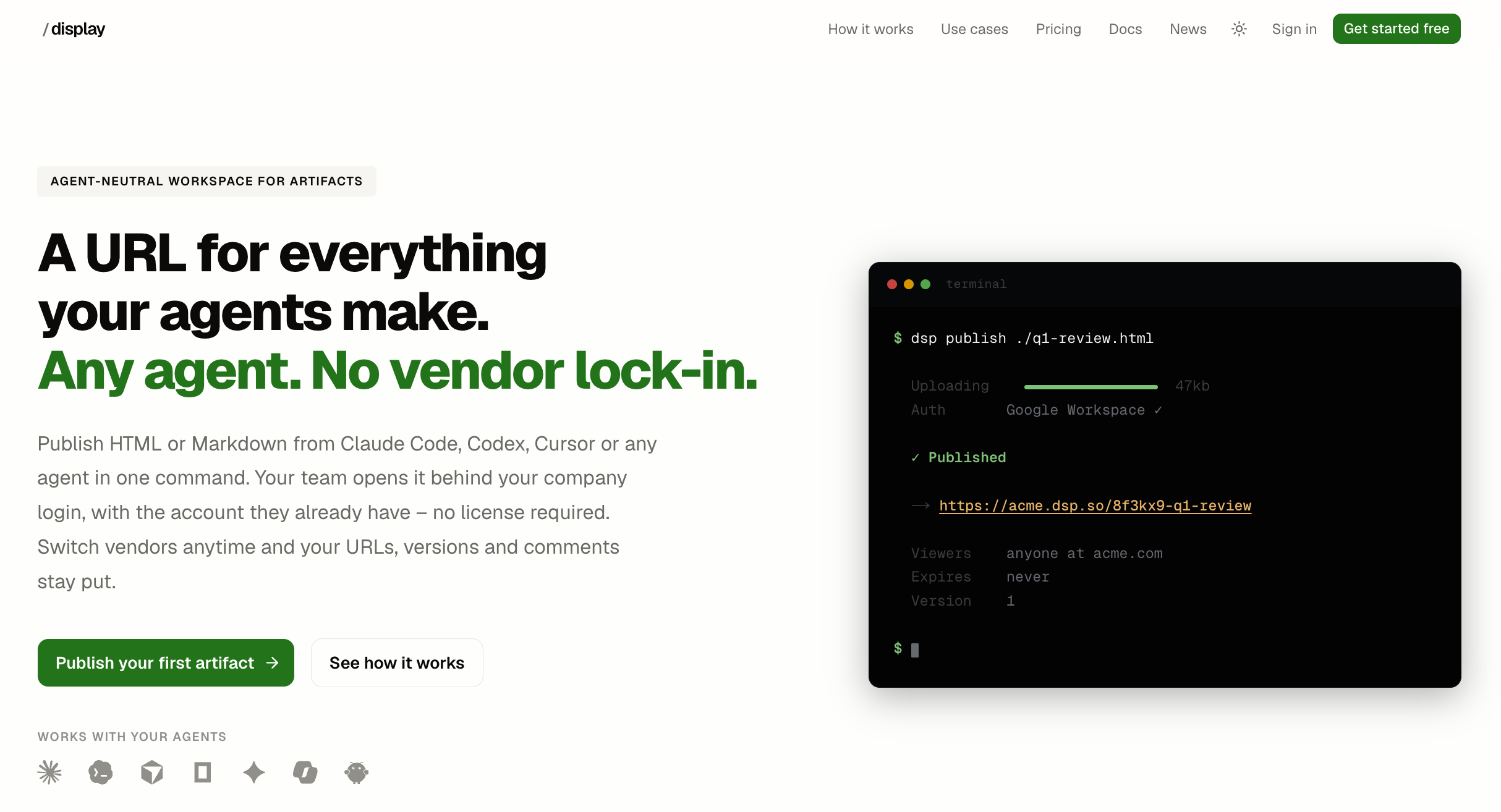
Display.dev is a gated publishing layer for agent-generated content. An agent publishes an HTML or Markdown artifact with a single command (via CLI or MCP), and it gets a permanent URL sitting behind company authentication - Google or Microsoft SSO, or a one-time password for people outside the org. Colleagues can view it, comment on it inline, and the agent can read those comments back in its next session and update the artifact accordingly. Versions and activity are logged, so there's a record of what was published and what was touched afterward.
Two design choices stood out to us.First, it's agent-agnostic: the same published artifact works whether it originated from Claude, Codex or Gemini, or something else, and can be updated by any of them later. Second, it's priced flat per organization rather than per seat, which matters for a tool meant to be used by everyone in a company, not just the people who happen to hold a paid seat in a particular AI product.
The team
Ott Ilves (CEO, commercial) and Carl Rannaberg (CTO, builder) first worked together at Pipedrive, and bring a complementary mix of commercial and engineering experience to the problem. Ott's an entrepreneur at his core, having previously scaled a platform from $0 to $12M, and brings that same GTM instinct to Display.dev. Carl experienced the problem firsthand while building agentic systems in his day job, and set out to build the tool he wished he'd had.
The market
Display.dev sits at the intersection of two trends: the rapid adoption of agents by both engineers and non-engineers, and enterprise demand for secure, auditable sharing of internal work. It's a young, fast-forming category, and Display.dev's edge comes from being focused on this workflow and from working across agent tools rather than locking users into one - a natural fit for teams that use more than one agent, and a structural advantage that's hard for a single-vendor incumbent to copy without opening up its own walled garden.
What excited us
What drew us in was a real, specific pain we could see other teams already running into, and the speed with which Display.dev proved it by onboarding paying users already across Australia, Japan, and Europe within weeks of shipping. This energy & speed of execution was rare and the paying users this early are a clear sign of a need & willingness to pay. We believe what they're doing is deeply strategic, streamlining the distribution of agent-generated content by becoming the layer every agent plugs into. As agent output keeps multiplying, a centralized repository where it's all stored, accessible, and auditable will become an enterprise necessity.
But what sealed it for us was the team. Talking to Ott and Carl, it was clear they'd thought hard about where agent-produced work is headed, and had already built something people were using daily to deal with it, not just theorizing about it. That's the kind of urgency and clarity we want to back
We're stoked to be working with Ott and Carl, and with Outlast and Firstpick as co-investors, as Display.dev takes this on.
The official press release can be read here - https://tech.eu/2026/07/07/displaydev-raises-eur470k-to-power-document-collaboration-for-ai-agents/
You can try out Display.Dev here for free and watch a product explainer video here on Youtube

